
Vocabulary carries its worldview within.
The words a market reaches for — the ones that surface in pitch decks, in boardrooms, in the frameworks we inherit — reveal not just what that market values, but what it assumes. What it takes for granted. What it has never had to question.
Developed-market business language tends to assume the underlying system already works. Infrastructure is stable. Transactions complete. Institutions hold. From that foundation, the vocabulary moves upward — toward preference, experience, optimization, delight. The system is given. The job at hand is to improve it.
Emergent market language cannot make that assumption. Here, the vocabulary that actually matters — the vocabulary you need to build something that works — stays close to the ground. It must. Because the ground keeps moving. Trust breaks and the customer doesn’t return. Access disappears and participation disappears with it. The words that survive in these environments are the ones that name what is actually precisely at stake: friction, waiting, reliability, proof, cash flow, distance. Words that ask whether the transaction happens at all before asking how it feels.
This is the vocabulary of emergent markets. And it is more precise than what replaced it.
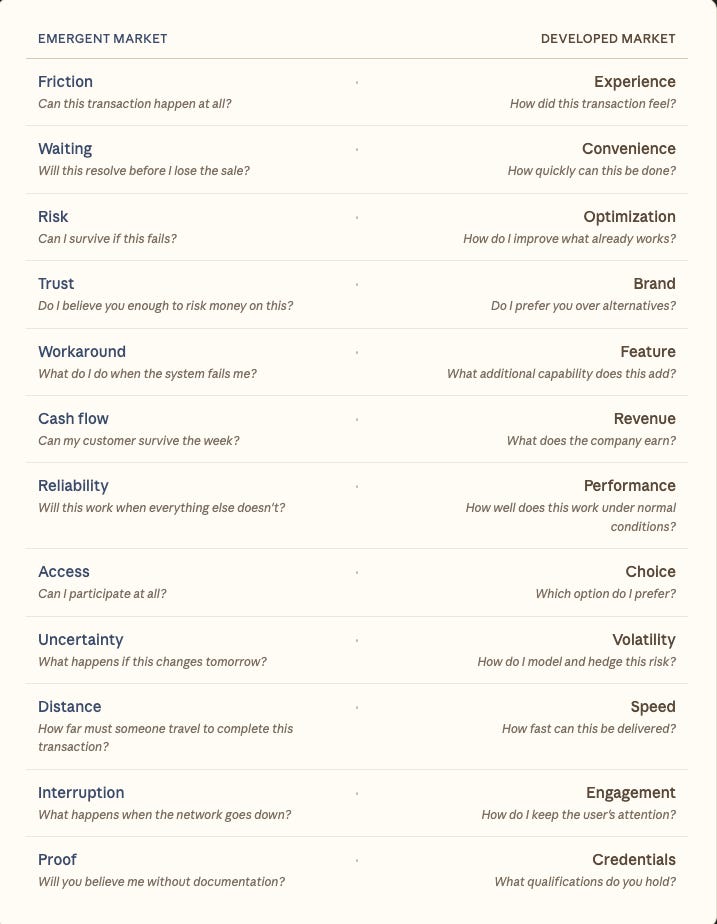
While a lack of sophistication is often blamed, the culprit here is the assumptions.
“Experience” assumes the transaction already works. “Friction” asks whether it works at all. “Brand” assumes institutional legitimacy exists. “Trust” asks whether people believe you enough to risk anything on it. “Choice” assumes abundance. “Access” assumes the door might be closed.
And then this: Revenue versus Cash flow. Revenue is what the company earns. Cash flow is whether the customer survives the week. These are not two measurements of the same thing. What they are is two entirely different orientations toward the same market. One starts from the company. The other starts from the person trying to participate in the economy.
The problem — and this is what this series is about — is that this vocabulary rarely makes it into the rooms where it matters most. When emergent market builders pitch, they reach for a different language. Innovation. Disruption. Technology-led growth. They’ve learned, often without noticing they’ve learned it, that the words closest to reality don’t travel well. Say “we removed the friction that stopped people from completing a cash transfer” and the room hears small, local, incremental. Say “we built an innovative fintech platform” and the room leans forward.
So you code-switch. And you keep code-switching. Until the borrowed language becomes the only language and the problem you once knew precisely disappears inside it.
The cost of that translation is real. Strategy follows language. When you spend enough time describing your business in words that don’t quite fit the mechanism, you start optimising for the description instead of the thing itself. Baby founders read TechCrunch and learn to want to disrupt. They look at Flutterwave and see technology. They look at M-Pesa and see innovation. They don’t see friction removal — not because it isn’t there, but because nobody handed them that word as the lens. So they build chasing disruption, and the mechanism that actually drives scale stays invisible. Even to them.
That’s what this series (and book) is trying to recover. A more honest vocabulary — one that names what’s actually working in these markets, so builders can do it on purpose.
In the next issue: the companies that looked for friction — and what happened when they found it.
What have you been translating away — and what did you lose in the translation?
These reflections sit alongside a longer body of work in progress — The Emergent Economy — which explores how markets form before institutions notice them.
So good.
I guess the cost of using the right terminology may cost baby founders some opportunities and that’s ok.
We need investors that get it.
innovative fintech platform is six words to describe something that could be said in two: 'money moves.' the shorter version is also harder to fund haha